
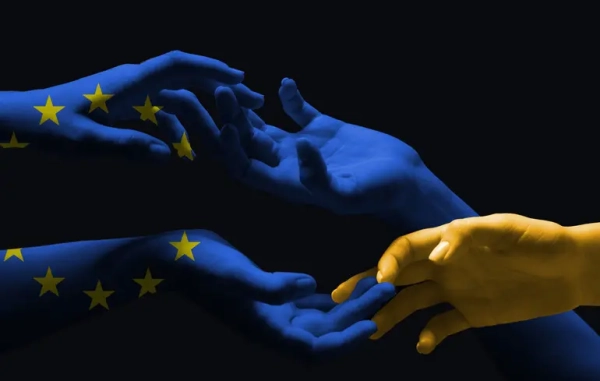
© depositphotos/[email protected] Europe needs its help as much as Ukraine needs Europe’s assistance.
Credit must be given to Europe for achieving what many believed impossible. After Donald Trump halted American military aid to Ukraine, Europe stepped up to fill the void. It accelerated the flow of funds and weaponry eastward and tightened sanctions against the Russian aggressor, as highlighted in The Economist’s analysis.
Partly due to European support, Russia’s significant battlefield losses are exerting increasing pressure on Vladimir Putin. With American diplomatic efforts to end the conflict effectively stalled, some in Europe are questioning whether the time has come for them to take the lead and initiate negotiations with the Russian leader.
That time may come, but not yet. A more pressing concern for Europe lies in its relationship with a nation that has transformed from a Western ward into a vital security partner. Ukraine’s war-hardened military is achieving successes, and its innovative defense industry is expanding. If Europe aims to safeguard its borders and reduce its reliance on transatlantic backing, it needs Ukraine just as much as Ukraine requires Europe. Europe’s priority should be the swift and complete integration of Ukraine into its fold.
For Ukraine itself, the objective has long been clear: full membership in the European Union to solidify its Western ties and compensate for territories seized by Russia. Four years after being granted candidate status, the EU is expected this month to open the first negotiation “cluster,” covering areas like democracy and the rule of law. Some in Kyiv are hopeful that full membership could be realized as early as next year. However, within the EU, even Ukraine’s staunchest proponents doubt this is feasible before a decade has passed. This divergence in expectations between the two sides poses a risk.
Part of the responsibility for this gap rests with Volodymyr Zelenskyy. The Ukrainian President must do more to bolster independent domestic institutions, particularly in the fight against corruption. He should also be more receptive to creative approaches that could allow Ukraine to take intermediate steps toward integration with the Union. Recently, German Chancellor Friedrich Merz proposed “associate membership” with limited voting rights as a transitional phase toward full accession. Zelenskyy too hastily dismissed this idea.
However, the primary challenge lies with Europeans themselves. Far too many of them still perceive Ukraine as a form of charitable project. In reality, Europe has much to learn from Ukraine, especially concerning drone technology, its production, and deployment. European armies can enhance their own security by investing in their neighbor. Sweden’s defense minister notes that weapons testing in Ukraine yields innovative results within weeks or months, whereas domestically, this process can take years or even decades.
Some Europeans are apprehensive about overly rapid convergence. They cite the risks of admitting a large, relatively impoverished, and institutionally fragile nation into the Union too quickly. These concerns are not unfounded, but they overlook the broader picture: Europe must act decisively to acquire greater hard power, essential for its own defense in an increasingly hostile world. Integrating Ukraine into the European sphere is a means of countering the evident regional threat posed by Russia. Enlargement is not merely a bureaucratic exercise; it is a geopolitical tool for a continent that appears vulnerable amidst increasingly aggressive major powers.
Other proposals, such as establishing a European Security Council that could include the United Kingdom, might help expedite the formation of a security partnership with Ukraine. Yet, the paramount priority must be to accelerate Ukraine’s EU accession process. The European Union should begin preparing an accession treaty now – as a signal of intent to the war-weary Ukrainians, as well as to investors who will finance the country’s post-war reconstruction. In return, Ukraine must be prepared to accept a delay in certain subsidies or freedom of movement rights to facilitate consensus-building within Europe.
The alternative appears grim. Polls indicate that a segment of young Ukrainians is beginning to lose enthusiasm for EU membership. This should serve as a wake-up call. After all, what is worse: admitting a poorer but enthusiastic Ukraine into the club, or leaving a powerful but disillusioned state outside its gates?