

The Kremlin masked a massive attack on Kyiv with a “response” to Ukraine for its strikes, but something went wrong.
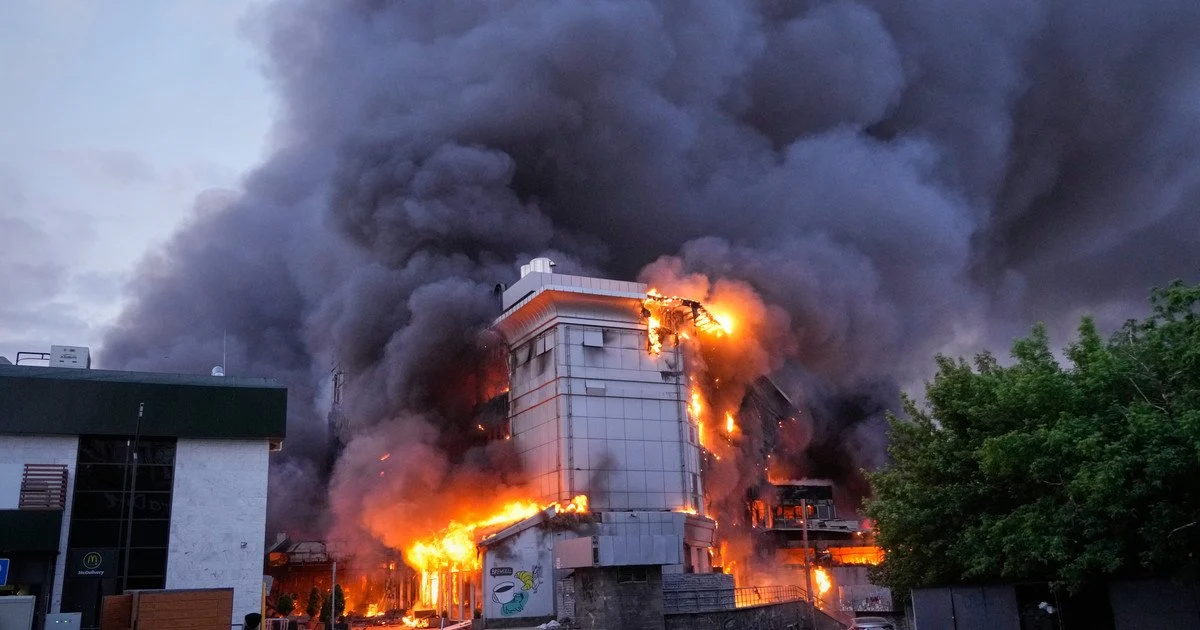
Attack on Kyiv on May 24. / © Associated Press
The Kremlin brazenly claims that the powerful strikes on Kyiv were allegedly a response to Ukraine’s attacks. However, this justification does not align with Russia’s historical pattern of behavior.
This is stated in a new report by the Institute for the Study of War (ISW).
Analysts emphasize that the Russian Foreign Ministry presented its threat against Kyiv as retaliation for alleged strikes on a college in occupied Luhansk Oblast, which Russia also used as justification for a series of strikes on the Ukrainian capital on May 23-24.
RF’s Threats to Attack Kyiv
It is noted that Russian Foreign Minister Sergey Lavrov called US Secretary of State Marco Rubio to inform him about the Russian threat to Kyiv and to spread the Kremlin’s information operation, which falsely portrays Ukraine and its European partners as undermining peace efforts.
“However, these justifications are weak. Aggressor Russia has historically launched its largest strike packages immediately before and after known bilateral or trilateral peace negotiations, which may likely disrupt and prolong the peace process,” the report states.
ISW emphasizes that Moscow has not provided irrefutable evidence that Ukraine’s strike on Starobilsk was directed exclusively at a civilian object, following claims that the occupiers created a military quarter on the territory of the affected college.
“Russia has previously created legitimate military targets in civilian buildings, likely attempting to use civilians and civilian infrastructure as human shields. The Kremlin is using this ambiguous situation to claim that Ukraine committed a war crime, although there is no clear evidence that this was necessarily the case,” the American analysts emphasize.
It is worth noting that the Russian Federation began to intensify strikes on Kyiv on the night of May 13, less than a day after the Victory Day ceasefire expired, and a week before the strike on Starobilsk.
Meanwhile, the Kremlin claimed that missile strikes and UAV attacks on Kyiv, consisting of over 90 missiles and 600 drones, were a response to the strike on Starobilsk, despite them occurring only a day later. However, Russia could not have assembled such a large-scale strike package or prepared for these strikes within 24-48 hours, and likely spent weeks preparing for such an intensification.
“The Kremlin is trying to present the May 23-24 attacks and any strikes in the coming days as retaliation for Starobilsk to conceal the real reason for the intensification of these strikes: masking the Kremlin’s embarrassment over the need for Ukraine’s permission to hold the Victory Day parade on May 9, Russia’s poor combat performance, and the growing economic costs and social tensions that the Kremlin is experiencing as a result of the over-year-long war,” the report states.
In addition, ISW notes, Moscow traditionally intensifies its attacks to divert attention from Russian failures or Ukrainian successes that have put the Kremlin in an awkward position. For example, the “Web” operation in June 2025, which revealed significant flaws in the protection of the Russian border and deep rear air defense.
American analysts also suggest that Russia is likely escalating its attacks on Kyiv to take advantage of the global shortage of Patriot interceptor missiles, which limits Ukraine’s ability to defend against missile attacks, particularly ballistic ones.
“The Kremlin is likely trying to soften the Western reaction, particularly from the US, to the intensified strikes on Ukraine and Kyiv in particular, by falsely portraying this escalation as a reaction to a specific incident, rather than as part of a broader scheme to escalate the war and avoid peace negotiations,” ISW emphasizes.
RF’s Violation of International Law
At the same time, the accusations by the Russian government of violations of international law by the Armed Forces of Ukraine are an attempt to divert attention from systematic violations of international law by the invaders, who have repeatedly abused Ukrainian prisoners of war and carried out executions on the battlefield, violating the Geneva Conventions. Moreover, the Russian military command either facilitates or directly orders these war crimes.
Russia has also violated the Geneva Conventions by forcibly mobilizing the civilian population in occupied Ukraine into the ranks of the Russian army, recruiting Ukrainian prisoners, abducting children from occupied regions, and intensifying efforts to deport them to summer camps in Russia and occupied territories in the summer of 2026.
Analysts also emphasize that the invaders regularly conduct “human safaris” along the front line, using tactical drones to “hunt” civilians and civilian infrastructure, and publish videos of strikes on civilian targets, including the May 14 strike on a UN vehicle in the Kherson region.
“This inexhaustible list of systematic violations of international law by the RF troops, particularly the statutes they accuse Ukrainian troops of violating, demonstrates only some of the crimes that the Kremlin is trying to distract from by accusing the Armed Forces of Ukraine of violations for which Moscow has provided no evidence. The occupiers’ own actions demonstrate that Russia itself does not take compliance with the principles of international law seriously, and its justifications for why it struck and plans to strike Kyiv are weak,” ISW concluded.
Recall that on the night of May 24, Russian troops once again carried out a massive combined strike on the capital, using ballistic missiles and attack drones. All districts of the capital were hit by the night attack. More than 40 locations across the city sustained damage, including many cultural landmarks.
Comments Sort by: New Old Popular Send