

During autumn and winter, Russia will attempt to launch massive strikes deep into Ukraine, employing new missile-drones and jet-powered UAVs.
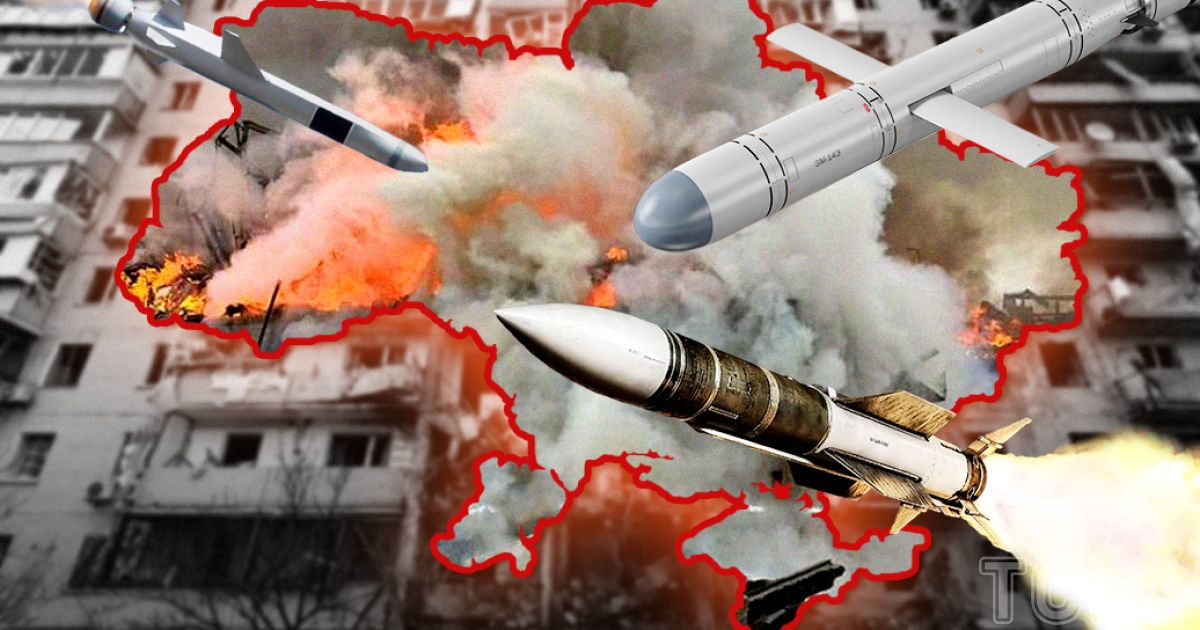
Missile attack on Ukraine / © TSN.ua
In winter, Russia might concentrate its attacks on Ukraine’s ports, energy system, and gas stations. French OSINT analyst Clément Molène has warned of the enemy’s increasing production of inexpensive jet-propelled missile-drones and the threat to nuclear power generation.
He shared this information in an interview with “Radio Free Europe.”
RF’s Winter Attacks on Ukraine: Where and How the Enemy Will Strike
“I believe they (Russians – ed.) will escalate the production of ‘Geran-4’, jet-powered missile-drones akin to ‘Geran-5’ or ‘Banderola’. This will also pose a challenge for ports and critical infrastructure, for instance, in Kyiv,” Molène stated.
According to him, the potential use of inexpensive jet-powered missile-drones by Russia for city attacks, in the absence of adequate air defense, “could be a very serious problem.”
The analyst suggests that one of Russia’s primary objectives will be to increase the production volume of ‘Geran-4’.
“I think escalating ‘Geran-4’ production is their priority. It costs, I believe, slightly more [than ‘Geran-2’], but they will still strive for economic efficiency by producing significantly more drones,” he warned.
Moving forward, Molène believes, the occupiers will likely continue to conduct medium-range strikes. Among potential targets, he names electrical substations, the disabling of which “could be a very serious problem.”
Protecting the Energy Sector
At the same time, the analyst noted that Ukraine is already taking steps to enhance the protection of its energy infrastructure.
“Ukraine has already started adapting. They are now reinforcing them: installing concrete protection around transformers at substations to shield them from drone attacks. This works, but it requires significant time and money to install all this concrete protection on very large facilities. This is one of the solutions,” Molène explained.
Russian Attacks on Gas Stations and the Weakness of Russia’s Approach
A separate threat, according to the expert, could be attacks on gas stations. Russia, in his opinion, will continue to use fiber-optic FPV drones for this purpose, creating risks for logistics near the front lines.
“I think soon they will be able to replicate Ukraine’s medium-range strikes using their own drones. They will likely be able to do this similarly to Ukraine – with relay drones in the air and FPV or other types of drones striking much further from the front line,” he warned.
However, Molène identifies Ukraine’s interceptor drones as the main weakness of this approach for the Russian Federation: “Ukraine has very well-developed interceptor drones, meaning they can easily take down these relay drones and prevent such attacks.”
Nevertheless, he advises against completely dismissing an increase in the number of such enemy attacks.
“But in some areas of the front, I think the scale of these attacks will grow. And this will become a problem, especially for air defense systems, artillery, and drone launch sites,” the analyst noted.
Energy Infrastructure is a Priority for Russian Attacks
Molène identified energy infrastructure as the most crucial target for Russian strikes. In his opinion, this could become one of Ukraine’s main challenges during the upcoming winter.
“If Russia strikes new targets, including power plants and some key energy facilities in the country, it could disconnect nuclear power generation from the national grid, meaning Ukraine would have to shut down its nuclear power plants,” he emphasized.
The expert explained that once nuclear power plants are shut down, their reconnection to the energy system might take a considerable amount of time, even after the relevant infrastructure is restored.
“This would mean that many key cities would remain without electricity during the winter, and many key industrial sectors would also lack electricity. This is one of the major problems Ukraine will face this winter,” he observed.
It is worth noting that according to Ukraine’s Ministry of Defense Main Intelligence Directorate, Russia does not plan for negotiations or a ceasefire before the end of the year. During autumn and winter, the enemy will focus strikes on the military-industrial complex, military facilities, logistics, and critical infrastructure—energy, heating, gas production, water supply, and power lines, against which Russians have developed specialized drones.
Related Topics
Shelling Russia Energy Gas Stations Comments Sort by: New Old Popular Send