
Such allies of Russia as Moldova, Armenia, Azerbaijan, Kazakhstan, and Uzbekistan have begun to distance themselves from Moscow and seek new partners since the start of the invasion of Ukraine.
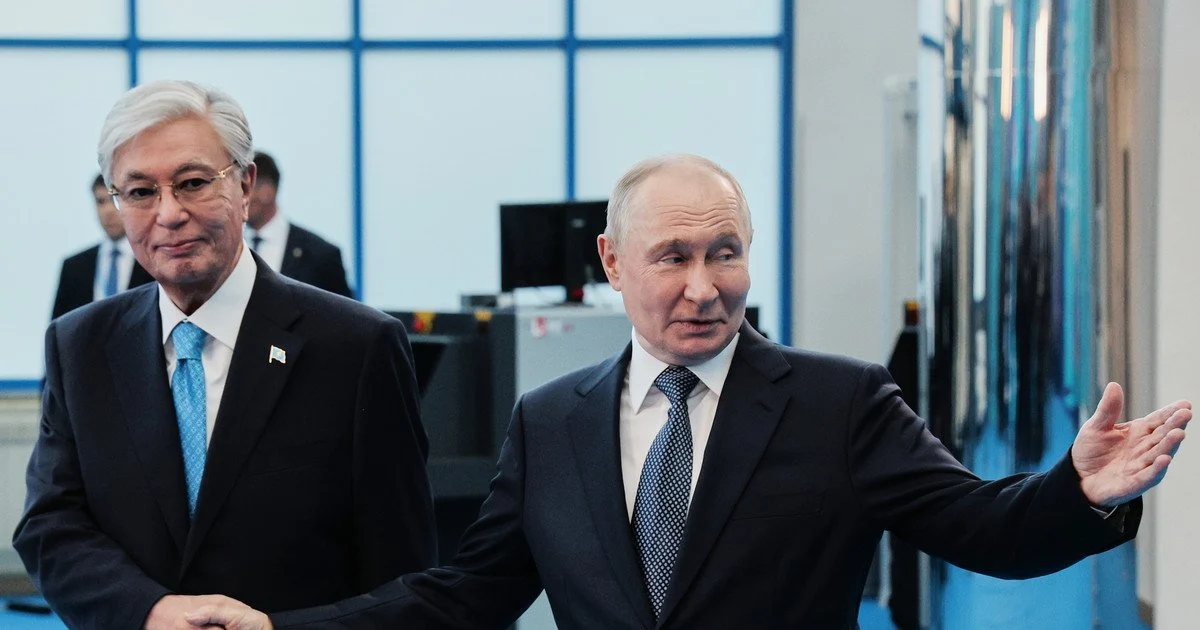
Volodymyr Putin and Kassym-Jomart Tokayev / © Associated Press
The full-scale invasion of Ukraine has shown Russia’s allies that it no longer holds significant political sway globally. Countries like Moldova have intensified their efforts to join the EU, while others are moving out from under Russian influence.
This is highlighted in an analytical article by Welt.
Moldova
Despite considerable internal political struggles, Moldova maintains its pro-European stance. In the fourth year of the war in Ukraine, Russia is perceived by Moldovan society as a threat rather than a partner. Since the summer of 2022, the country has been an EU candidate, with official accession talks commencing in June 2024. A referendum on accession in October 2024 resulted in a narrow victory for pro-European forces.
According to a New York Times report, Putin views Moldova as his primary target after Ukraine, both for pressuring Kyiv from the West and for destabilizing the EU.
Russia appears to be focusing more on training potential saboteurs from Moldova than on exerting political pressure through the traditionally pro-Russian breakaway region of Transnistria.
Armenia
Russia is also losing Armenia as an ally. Russian interference in Armenian affairs has recently proven unsuccessful. Prime Minister Nikol Pashinyan’s “Civil Contract” party secured a majority in the June parliamentary elections, despite Putin’s indirect support for one of his opponents. Although Pashinyan still maintains friendly rhetoric towards Putin, for him and the majority of Armenians, one thing is clear: Russia can no longer be relied upon, according to German journalists.
Welt suggests that Armenia is disillusioned due to Russia’s lack of support when Azerbaijan reclaimed Nagorno-Karabakh and expelled its inhabitants who had been living there since 2020.
“Pashinyan aims to lead his country into the EU and seeks security cooperation with France, which has been formalized as a strategic partnership this year. Another significant partner is India, which has become the primary arms supplier for the Caucasian nation,” the article notes.
Journalists believe that Yerevan’s geopolitical detachment from Moscow will not be easy, as a portion of its exports currently goes to Russia. Furthermore, Russian state-owned companies control the Armenian railway and parts of its energy infrastructure.
Azerbaijan
Despite the reclamation of Nagorno-Karabakh, Russia is losing Azerbaijan. Moscow had kept the conflict in limbo for decades, arming both sides. With Armenia’s defeat, Moscow’s most crucial leverage over Azerbaijan has disappeared, as explained by Welt.
However, despite the downing of an Azerbaijani airliner by Russian air defense systems in 2024, Baku is not entirely distancing itself from Moscow. Russia is becoming one of many partners in a diversified foreign policy strategy.
Interestingly, Baku is moving closer to Yerevan, with the mediation of the United States. However, the ratification of a peace agreement, initiated by Donald Trump in 2025, is still pending. For the first time in decades, there is minor transit traffic between the two countries. Even Europeans are purchasing Azerbaijani gas.
Azerbaijan also maintains diplomatic ties with Turkey, which significantly contributed to the recovery of Nagorno-Karabakh through drone exports, and Pakistan, a supplier of weapons. Additionally, there is a strategic partnership with China, primarily in the field of renewable energy.
Kazakhstan
Even under the predecessor of the current president, Kassym-Jomart Tokayev, Nursultan Nazarbayev, Kazakhstan pioneered a “multi-vector foreign policy” in the post-Soviet space, with primary directions towards Russia, China, the USA, and the EU.
At the same time, as during Nazarbayev’s tenure, Kazakhstan remains a “personalist autocracy.” The self-proclaimed “Father of the Nation” effectively disappeared from the political scene in early 2022 following mass unrest and a power change supported by Russia.
Kazakhstan’s economy relies on the export of oil, uranium, zinc, and other mineral resources. It seeks good relations with Turkey, Japan, South Korea, and the monarchies of the Persian Gulf.
“This course has weakened Russia’s role in the country for years. The annexation of Crimea and the invasion of Ukraine provided new arguments for cautious distancing from Russia. To mitigate dependence on the Russian Federation, Tokayev is focusing more on China, particularly in technology and transit routes, while simultaneously trying to balance the ambitions of both China and Russia. The EU is already Kazakhstan’s largest trading partner,” the article states.
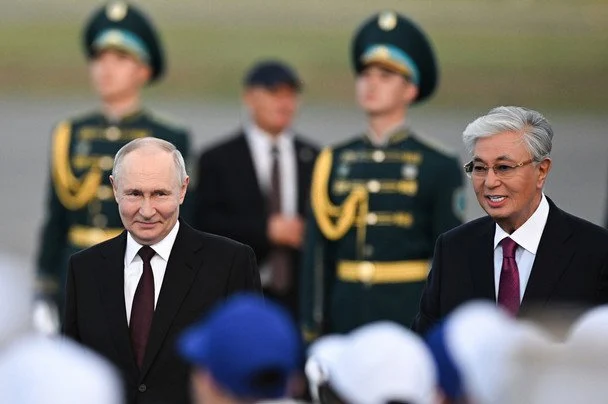
Volodymyr Putin and Kassym-Jomart Tokayev / © Associated Press
Uzbekistan
For the first 15 years after gaining independence, gas-rich Uzbekistan remained isolated from the outside world. Then-President Islam Karimov trusted neither Russia nor the West and pursued a rather closed policy.
Following Karimov’s death in 2016, his successor, Prime Minister Shavkat Mirziyoyev, took office. He began to open the country to foreign investment and cooperate more actively with the world, but he did not democratize the political system.
Mirziyoyev also appoints his relatives to influential state positions. Experts note that his public rhetoric increasingly displays features of a personality cult, similar to the one previously cultivated by Karimov. However, this has not deterred foreign investors from channeling funds into the country.
A journalist notes that today, China is the largest donor, with investments exceeding ten billion dollars. This is followed by Russia, the Persian Gulf states, and Turkey, as well as European countries.
In foreign policy, Mirziyoyev views Kazakhstan as a model. Russia remains an important partner, but not the sole option. China is currently the most significant trading partner and the largest buyer of Uzbek gas exports.
We previously reported that Central Asian and South Caucasus countries are increasingly refraining from so-called Kremlin support. They are building their own political, economic, and security ties without Russian involvement.
Related topics
Russia Kazakhstan Comments Sort: New Old Popular Send