
“Alternative” closer to power: how the far-right could destabilize Germany and harm Ukraine
Friday, August 28, 2026, 11:59 AM — Khrystyna Bondarieva, European PravdaShare:
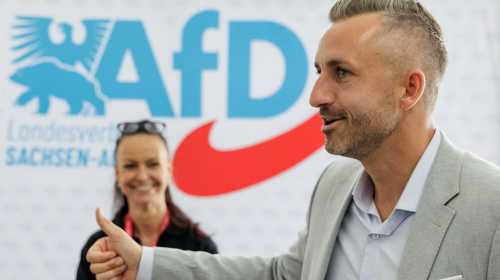
JENS SCHLUTER/AFP/East NewsUlrich Sigmund will become the Minister-President of Saxony-Anhalt if the “AfD” wins a majority in parliament after the September 6 elections.
At the end of July, the British publication The Telegraph published a report on the secret plans of Friedrich Merz’s government in case individual German states attempt to obstruct the implementation of NATO’s defense plans in the event of a threat of Russian aggression.
This primarily concerns Saxony-Anhalt and Mecklenburg-Vorpommern, where the far-right “Alternative for Germany” (“AfD”) is predicted to achieve a high result in the September state elections.
If the “AfD” wins an absolute majority and forms a government in at least one of these states, it will gain control over internal security and a range of administrative procedures. This, in particular, could allow the creation of bureaucratic obstacles for the movement of NATO troops and equipment and slow down their transfer to the Alliance’s eastern flank.
The potential sole rule of the “AfD” will have consequences far beyond military logistics.
The formation of the first state government in the history of modern Germany led by the “AfD” could increase political instability in the country and provoke serious confrontation between state and federal authorities. And in the longer term, it could weaken Germany’s role as one of Europe’s key leaders, particularly in supporting Ukraine.
On the Threshold of Power
The “Alternative for Germany” will have its first chance to form a government independently on September 6, in the elections to the state parliament (Landtag) in Saxony-Anhalt (elections in Mecklenburg-Vorpommern will be held two weeks later).
According to the latest polls, about 42% of voters in Saxony-Anhalt are ready to vote for the “AfD”. In the last elections in 2021, the party received 20.8% of the votes – meaning its support has doubled in the last five years.
The closest competitor to the “AfD” is the Christian Democratic Union (CDU) of Chancellor Friedrich Merz. It is a representative of the CDU who currently heads the state government, and the Christian Democrats are supported by about 22% of voters.
The “Left” party (about 12% support) and the Social Democratic Party of Germany (SPD, over 7%) are also projected to enter the Landtag, while the Greens and Sahra Wagenknecht’s Alliance are hovering on the brink of the 5% threshold.
At the same time, 42% does not guarantee the “AfD” an absolute majority in the Landtag.
And, consequently, the opportunity to form a government.
Although, the final number of mandates received by the “AfD” could increase if the aforementioned Greens, Sahra Wagenknecht’s Alliance, and smaller parties do not make it into the Landtag – then a significant portion of their votes would ultimately go to the far-right.
If the party becomes the largest faction, but lacks a few deputies to form a government on its own, the main issue will be forming a coalition without the far-right.
And at the center of these negotiations will be the CDU, which adheres to the so-called “firewall” – the principle of not entering into coalitions or any other forms of political cooperation with the “AfD”. Furthermore, the Christian Democrats have so far refused any formal coalitions with the “Left”.
So, there are few options left, and the most likely, though not problem-free, scenario would be a minority government with the Social Democrats, with situational support from other parties.
The “AfD” itself expects a different scenario.
Party leader Alice Weidel believes the party will gain enough in the elections to form a government independently. If this happens, it will be a historical precedent for Germany.
Since its founding in 2013, the “Alternative for Germany” has not led the government of any of the 16 states and has not entered into governing coalitions at the federal level due to the same “firewall”.
If the “AfD” has an absolute majority of mandates, other forces will not be able to block its rise to power. The far-right will gain full control over the executive power of the state, and the party’s candidate Ulrich Sigmund, whom the publication Spiegel called “the most dangerous man in the country,” will become Minister-President.
Protection from Russian spies
The rise to power of the “AfD” led by Sigmund could trigger a serious confrontation between the new government of Saxony-Anhalt and the federal government and other German states. And it will primarily concern sensitive data.
In Berlin and several state capitals, informal discussions are already underway on how to “turn a blind eye and deaf ear” to the far-right.
In Germany, the governments of the 16 states coordinate their work regularly through special ministerial conferences. One of the most important is the conference of interior ministers, where issues of security and the exchange of intelligence information are discussed.
Currently, German officials are considering restricting the access of the future government of Saxony-Anhalt to information in the areas of internal security and intelligence. And Defense Minister Boris Pistorius has openly advocated for excluding AfD state ministers from the process of exchanging classified data.
One of the options being discussed by German officials is to hold additional informal meetings on highly sensitive issues, to which the representative of Saxony-Anhalt would simply not be invited. Formally, the work of joint bodies would not cease, but the most critical information would be discussed in a different format.
The reason for these concerns is the foreign policy orientation of the far-right and fears that the “AfD” is leaking classified data to Moscow.
At the same time, it will be impossible to completely exclude Saxony-Anhalt from intelligence data exchange.
In particular, due to the need to ensure public safety and prevent terrorist attacks.
Therefore, a variant of data segmentation is also being considered, whereby data on right-wing extremism and espionage could be separated from systems accessible to the “AfD” government.
Another potential lever of pressure on the “AfD” government could be the system of financial equalization between the states, on which Saxony-Anhalt is significantly dependent. In 2025, it received about 2.8 billion euros through this system, almost a fifth of the state budget. The financial whip could become a kind of blackmail element from Berlin, which would prompt the “AfD” government to “obedient behavior” and serve as punishment for any potential espionage for the Russian Federation.
And the harshest instrument of influence is considered to be federal enforcement (Bundeszwang). This is a mechanism by which the German government, with the consent of the Bundesrat, can simply force state authorities to comply with federal laws if they do not. This applies not only to the obligation to protect security-critical data but also to a wider range of issues: migration, refugee rights, etc.
Such a mechanism, called the “nuclear option,” has never been used before.
If the “AfD” truly comes to power, Berlin will almost certainly be forced to take significant security precautions regarding classified data. Because if Germany’s allies suspect that critical information could reach Russia through the “AfD” government, they will simply stop sharing such data with Berlin.
A similar precedent already occurred in Austria under the Freedom Party’s government: after the police, controlled by the far-right minister, raided the headquarters of the Austrian intelligence service in 2018 and gained access to classified information, cooperation with foreign partners in intelligence sharing was restricted.
NATO’s Weak Link
Security challenges for Berlin will not be limited to intelligence sharing. If the “AfD” comes to power, the question will arise as to how much the federal government and its allies can rely on state authorities at a critical moment.
Germany is a central link in NATO’s military logistics in Europe. Key routes pass through its territory, along which allied troops and equipment must move in the event of a threat of Russian aggression. Because of this, the country is informally called NATO’s “roundabout”.
Military logistics are critically important not only for NATO countries.
Ukraine also receives military assistance through German logistical corridors.
A pro-Russian “AfD” government, it is believed in Berlin, would not necessarily openly block the movement of military equipment and personnel. However, it could delay the issuance of permits for the transportation of heavy equipment, not give priority to military on local roads, or slowly allocate police resources.
This is critical for NATO: moving tanks, howitzers, and other equipment across Europe requires numerous customs, diplomatic, and administrative permits. And only after obtaining them can the Alliance begin deploying forces to the eastern flank. According to a Western defense source cited by The Telegraph, this process takes five to six weeks. It is precisely such bureaucratic “bottlenecks” that Russia could use in its hybrid war, parallel to sabotage and cyberattacks.
Therefore, Friedrich Merz’s government is already developing scenarios in case an individual state attempts to obstruct federal defense policy.
This includes mechanisms that would allow limiting the powers of “rebellious” state governments in a crisis and protecting critical infrastructure and key officials in neighboring states.
Chancellor in Turbulence
A significant success for the “AfD” in Saxony-Anhalt will have serious political consequences for Chancellor Friedrich Merz, who is already under political pressure and whose popularity regularly sets new anti-records.
In recent weeks, German and international media have reported discussions about Merz’s possible successor. Not entirely successful cabinet reshuffles have also added to the tension.
The election results in Saxony-Anhalt could intensify such internal party discussions, as the question will inevitably arise within the CDU: is the party leader capable of stopping the “AfD” before the 2029 federal elections if, under his leadership, the party loses ground even where it has always been strong?
Another point is that Merz’s argument for defending the “firewall” could be significantly undermined, and proponents of an alliance with the far-right will begin to ask: you have isolated the “AfD” for so many years, and it has still come to power, so perhaps it is worth cooperating rather than confronting?
Of course, the CDU is unlikely to immediately demand a coalition with the far-right.
But calls to revise the “firewall” will almost certainly become louder.
Indeed, such signals are already emerging. On the eve of the elections, one local CDU politician in Saxony-Anhalt, Bernd Prange, donated 10,000 euros to the “AfD” and called on the CDU to reconsider its separation from the party. Also indicative was the position of Michael Kretschmer, the Minister-President of the eastern state of Saxony, who considers the “firewall” outdated.
In addition, a strong result for the far-right could push part of the CDU towards demanding changes not only in their attitude towards the “AfD” but also in the political course of the Christian Democrats themselves. The more radical wing of the conservatives may insist on a tougher stance on migration, security, and energy to win back voters being wooed by the “AfD”.
Consequences for Ukraine
Berlin’s interaction with a politically specific state, the growing support for the “AfD,” and discussions about the future of the chancellor himself could weaken Germany’s political position in Europe.
A government preoccupied with internal problems will have less opportunity and political resources to play the role of one of the main engines of European policy.
This also applies to supporting Ukraine. The “AfD” opposes Berlin’s current course towards Russia and Ukraine, and its success will increase pressure on Merz.
The leader of the “AfD” in Saxony-Anhalt, Ulrich Sigmund, calls the spending on supporting Ukraine money that Germany lacks and claims that sanctions and trade restrictions against Russia are allegedly causing price increases.
This, of course, does not mean an automatic reduction in aid to Ukraine, as foreign policy remains the responsibility of the federal government. However, it could make the government more cautious in decisions that require significant resources or politically complex steps.
And for Kyiv, it is important that Germany remains not only one of the largest donors but also a political leader in Europe in supporting Ukraine.
Author: Khrystyna Bondarieva,
Journalist of “European Pravda”Subscribe to “European Pravda”!If you notice an error, highlight the required text and press Ctrl + Enter to report it to the editorial office.